Wai-O-Tapu vs Whakarewarewa
Wai-O-Tapu is a self-guided walk through coloured geothermal pools. Whakarewarewa – The Living Māori Village is a guided visit to a community that still cooks and bathes in its hot springs. Here is how they differ from each other and from Te Puia, and how to do both in a day.
Wai-O-Tapu is about the geothermal landscape itself: coloured pools, craters and a geyser, seen on a self-guided walk 31 km south of Rotorua. Whakarewarewa – The Living Māori Village is about people. The Tūhourangi and Ngāti Wāhiao families who live there have cooked, bathed and guided visitors in the hot springs of the Whakarewarewa valley for generations, and a village guide walks you through it.
Pick Wai-O-Tapu if you came for the scenery and the photographs, and Whakarewarewa if you want to understand how a Māori community lives with geothermal activity. Most people with a full day in Rotorua can do both.
Check Availability
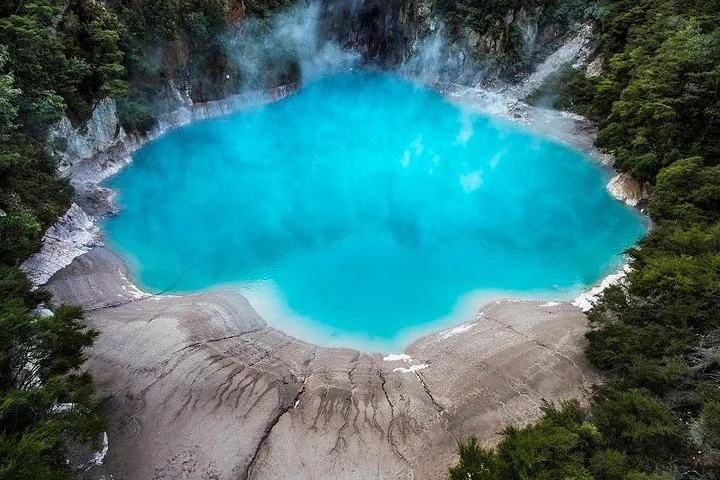
Rotorua based Small Group Morning Tour Waimangu and Wai O Tapu
- 4.9/5 (394 reviews)
- 5 hours
- Free cancellation
- Guide: DE, EN, ES, FR, IT
Includes Hotel pickup and drop-off · Local guide · Driver/guide
You'll choose your date and complete the booking on Viator. Free cancellation under Viator's standard terms; the booking page shows the deadline.
Quick answer
Choose Wai-O-Tapu for geothermal scenery you can photograph at your own pace. Choose Whakarewarewa for a living Māori cultural experience in a geothermal setting, with a guide from the village.
| Wai-O-Tapu | Whakarewarewa – The Living Māori Village | |
|---|---|---|
| Where | 31 km south of Rotorua on SH5, about 27 minutes by car | 17 Tryon Street, on the southern edge of Rotorua |
| Hours | 8:30 AM to 4:30 PM, last admission 3 PM | 8:30 AM to 4 PM, last guided tour 3 PM; closed 24 and 25 December |
| Entry | NZ$49 adult, NZ$18 child | Guided tour NZ$58 adult, NZ$29 child (5–15) |
| Format | Self-guided walking tracks | One-hour guided tour, hourly from 9 AM |
| Highlights | Champagne Pool, Devil’s Bath, Lady Knox Geyser | Village life, hot-pool cooking, a cultural performance at 12:30 PM |
| Without a car | Tour or shuttle | Taxi or a short drive from the city centre |
Other Experiences
Other experiences you might enjoy
Book the village tour direct from Whakarewarewa's own Viator listing, add the geothermal trails with the combo, or come from Auckland on a day tour that pairs Wai-O-Tapu with an afternoon at the village.
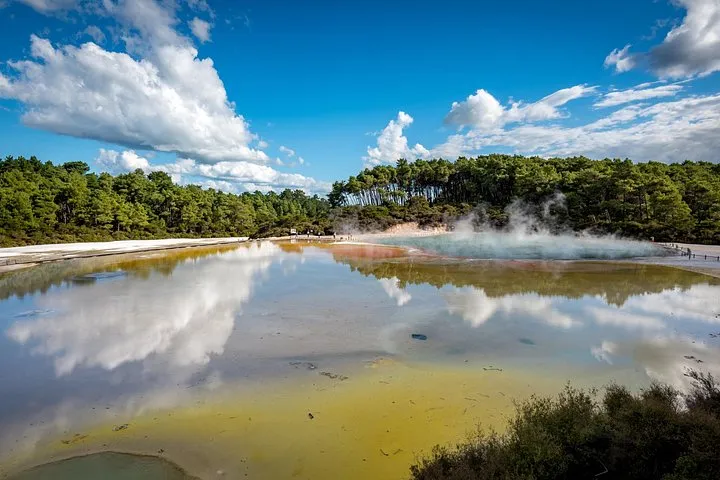 From Auckland to Rotorua Waiotapu and Activity Combinations
Start your Rotorua adventure at Wai-O-Tapu Thermal Wonderland, home to vibrant geothermal features like the Champagne Pool, bubbling mud pools, and steaming vents.
From $207
Wai-O-Tapu
Best for coloured mineral pools, the Champagne Pool, photography, volcanic craters and self-guided walking. You choose how long to spend on each of the three connected tracks, and the Lady Knox Geyser is presented at 10:15 AM each day.
A Wai-O-Tapu admission ticket costs from US$29 on Viator (4.4/5 from 562 reviews); see our ticket and price guide for what it covers.
Whakarewarewa
Best for local Māori guiding, the context of a village where people still live, geothermal cooking and bathing traditions, a cultural performance, and views across the Whakarewarewa geothermal valley.
The village is run by its own residents, and you can enter the village only with a guide. The Whakarewarewa village guided tour takes an hour and leaves roughly every hour from 9 AM, with the last at 3 PM. Guides are descendants of the village’s early guides, and the tour covers how families use the hot pools for cooking and bathing, with views of Pōhutu Geyser across the valley. On Viator it costs from US$33 and is rated 4.7/5 from 541 reviews.
The village’s cultural performance runs daily at 12:30 PM for about 30 minutes, with extra performances added in summer (US$23, 4.6/5 from 38 reviews). The village also sells hāngī food, including hāngī pies; ask at admissions what is on that day, because times and menus are not published.
If you want more walking, the Whaka trails and village combo (US$50, 4.7/5 from 199 reviews) adds the self-guided Whaka Geothermal Trails, with mud pools and steaming lakes, and a corn cob cooked in a hot pool. The trails on their own do not give you access to Pōhutu.
On the official site, the village tour is NZ$58 for adults, NZ$29 for children aged 5 to 15 and NZ$156.60 for a family of two adults and up to four children (rates for 1 October 2026 to 30 September 2027). The all-day pass, which adds the 12:30 PM performance and the trails, is NZ$123.30 for adults and NZ$63 for children.
Whakarewarewa village is not Te Puia
Both sit on the Te Whakarewarewa geothermal valley, and both look out on Pōhutu, so they are easy to confuse. They are separate attractions with separate entrances and tickets. Te Puia, on Hemo Road, is home to the New Zealand Māori Arts and Crafts Institute and the Kiwi Conservation Centre, and Pōhutu is its headline feature. Whakarewarewa village, on Tryon Street, is a residential village run by the families who live there. Our Wai-O-Tapu vs Te Puia guide covers Te Puia in detail.
Landscape vs culture
Decide what you want from the afternoon: a landscape to look at, or the story of the people who live in one. Wai-O-Tapu has more colour and more geothermal variety. At Whakarewarewa you see less spectacle, but you hear from someone whose family has lived beside the pools for generations.
Can you visit both?
Yes. Wai-O-Tapu in the morning and Whakarewarewa in the afternoon makes a full day in Rotorua: geothermal landscape first, then living Māori culture.
Arrive at Wai-O-Tapu by 9:45 AM for Lady Knox, walk the tracks, and drive back towards the city. Whakarewarewa is on the southern side of Rotorua, so it is on your way back in, and an afternoon village tour at 1 PM, 2 PM or 3 PM fits. If you want the 12:30 PM performance, see the village before Wai-O-Tapu, or keep the Wai-O-Tapu visit short.
Without a car, the small-group morning tour from Rotorua (US$140, 4.8/5 from 394 reviews) covers Wai-O-Tapu and Waimangu and has you back in Rotorua around 1 PM, leaving the afternoon for the village. From Auckland, the Auckland day tour with a choice of Rotorua afternoon activity (US$207, 4.8/5 from 15 reviews) visits Wai-O-Tapu and lists Whakarewarewa village among its afternoon options. It has few reviews so far, so confirm the village is available on your date before you book.
Without a car
Whakarewarewa is the easier of the two because it is in Rotorua: a short taxi ride or drive from the city centre. Wai-O-Tapu needs a car, a shuttle or a tour. Our guide to getting to Wai-O-Tapu from Rotorua compares the options.
Practical planning essentials
- Wai-O-Tapu is about 31 km from Rotorua, roughly a 27-minute drive in normal conditions.
- Wai-O-Tapu is open 8:30 AM to 4:30 PM, with final admission at 3 PM. Check the official site before you travel, because operating details can change.
- Lady Knox Geyser is presented at 10:15 AM daily; Wai-O-Tapu recommends arriving by 9:45 AM if you want to see it.
- The main geothermal park at Wai-O-Tapu is self-guided, with three connected walking tracks, so you can shorten or extend the route.
- Whakarewarewa village is open 8:30 AM to 4 PM. The last guided tour leaves at 3 PM and the last trails ticket is sold at 3:15 PM; the village closes to the public at 4 PM.
- Wear comfortable walking shoes and bring layers, rain protection, water, sunscreen and a charged phone or camera.
- There are no toilets inside Wai-O-Tapu’s main geothermal park or at Lady Knox, so use the Visitor Centre facilities first.
Final thoughts
Wai-O-Tapu works best when you plan the day around what you want to experience, instead of trying to collect every Rotorua attraction at once. Give the geothermal landscape enough time, keep fixed times such as Lady Knox in mind, and leave a buffer for driving and weather. If you have a spare hour in the city as well, Wai-O-Tapu vs Kuirau Park covers Rotorua’s free geothermal park.
Sources
Checked 30 October 2026: Wai-O-Tapu visitor information (hours, final admission, Lady Knox time and arrival advice, toilets, three connected tracks, 31 km / 27 min from Rotorua), Whakarewarewa – The Living Māori Village (address, opening hours, last tour and ticket times, Christmas closure), Whakarewarewa guided village tour (2026–27 prices, one-hour duration, departure times, Pōhutu views, 12:30 PM performance), Whakarewarewa all-day pass (price, inclusions, performance length and summer extras), RotoruaNZ. Tour prices, ratings and review counts from the live Viator listings.
See Wai-O-Tapu in the morning
The small-group morning tour has you back in Rotorua around 1 PM, in time for an afternoon village tour at Whakarewarewa.
Check Availability & Book