Wai-O-Tapu vs Te Puia — Which One, and Can You Do Both?
Wai-O-Tapu is the colour, Te Puia is the geyser and the culture. A straight comparison of the two Rotorua thermal parks, plus the tours that fit both into one day.
Wai-O-Tapu and Te Puia are two of Rotorua’s best-known geothermal attractions, but they answer different travel questions. Wai-O-Tapu is primarily landscape; Te Puia combines geothermal activity with Māori culture. Choose by the experience you want rather than assuming the parks are interchangeable.
The combined tour below departs from Auckland. If you are already in Rotorua, use the separate admission and local transport choices in this guide instead.
Check Availability
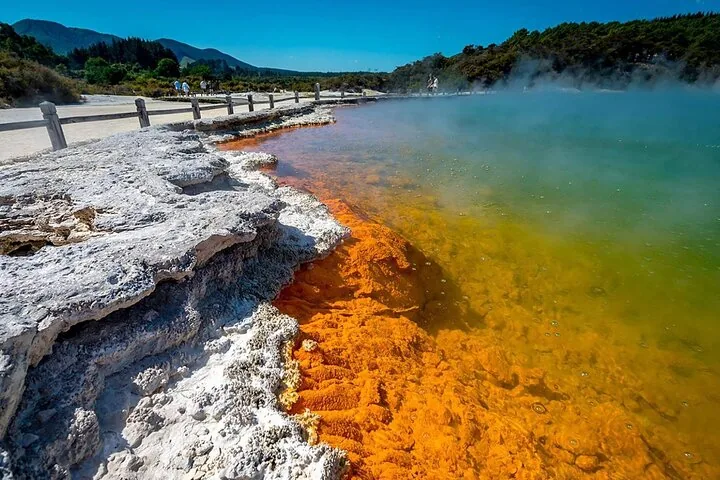
Auckland: Rotorua Tour with Waiotapu, Te Puia and Maori Haka
- 5.0/5 (136 reviews)
- 12 hours
- Free cancellation
- Guide: EN
Includes Admission to Wai-O-Tapu · Bottled water · All Fees and Taxes
You'll choose your date and complete the booking on Viator. Reserve now, pay later on most departures.
Quick answer
Choose Wai-O-Tapu for colour and independent walking; choose Te Puia for a natural geyser and Māori cultural interpretation. They complement one another if you have time for both. For a wider choice, see Wai-O-Tapu vs Te Puia vs Waimangu.
Wai-O-Tapu strengths
Colourful mineral pools, Champagne Pool, self-guided photography, Lady Knox and the separate Mud Pool are the main attractions. Wai-O-Tapu park admission is the independent option if you can arrange transport; hotel pickup is not included.
Other Experiences
Other experiences you might enjoy
Book either park independently, or choose a guided Wai-O-Tapu and Waimangu morning from Rotorua. The featured two-park tour above departs from Auckland.
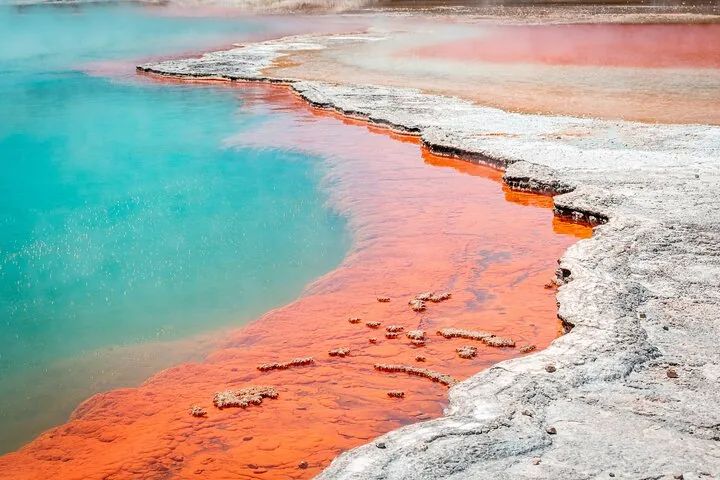 Wai-O-Tapu Thermal Wonderland, Rotorua, New Zealand
Thousands of Years in the Making a Wonderland of Stunning Geothermal Activity.
From $29
Te Puia: Te Rā Guided Experience
Guided geothermal valley visit, Kiwi Conservation Centre and Māori arts and crafts. Meet at Te Puia; select a performance upgrade if wanted.
Check current price
Wai-O-Tapu Thermal Wonderland, Rotorua, New Zealand
Thousands of Years in the Making a Wonderland of Stunning Geothermal Activity.
From $29
Te Puia: Te Rā Guided Experience
Guided geothermal valley visit, Kiwi Conservation Centre and Māori arts and crafts. Meet at Te Puia; select a performance upgrade if wanted.
Check current price
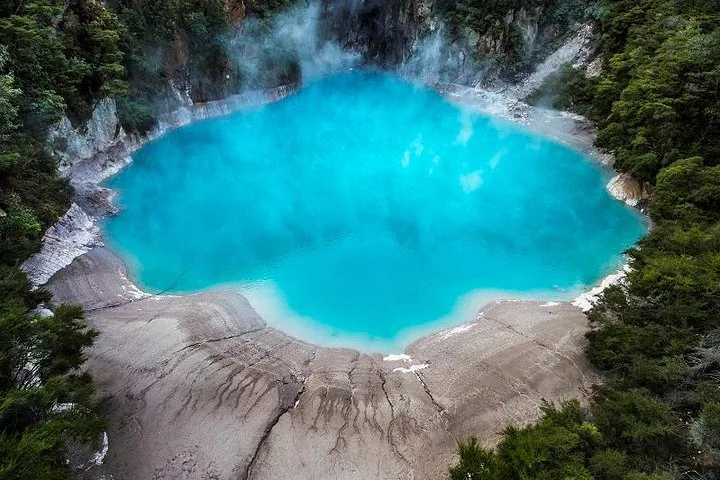 Rotorua based Small Group Morning Tour Waimangu and Wai O Tapu
Join a small-group morning tour from Rotorua to explore two top geothermal parks: Wai-O-Tapu Thermal Wonderland and Waimangu Volcanic Valley.
From $140
Rotorua based Small Group Morning Tour Waimangu and Wai O Tapu
Join a small-group morning tour from Rotorua to explore two top geothermal parks: Wai-O-Tapu Thermal Wonderland and Waimangu Volcanic Valley.
From $140The one-line difference
Wai-O-Tapu is the colour. Te Puia is the geyser and the culture.
Wai-O-Tapu is a 27-minute drive south of Rotorua, part of a geothermal system extending over 18 square kilometres, with three connected walking tracks through colourful mineral scenery: Champagne Pool with its orange rim, the shifting yellows and greens of the Artist’s Palette, the acid-green Devil’s Bath. The independent visit centres on the geothermal features and walking tracks.
Te Puia is in Rotorua itself, in the Whakarewarewa geothermal valley. Its headline feature is Pōhutu, the largest active geyser in the southern hemisphere, which erupts naturally many times a day rather than once on a schedule. But the site is really a cultural institution: it houses New Zealand’s national Māori carving and weaving schools, and its programmes include haka performances, a kiwi conservation centre and hāngī dining options. Performances and meals depend on the package selected.
Te Puia strengths
Pōhutu Geyser, guided interpretation, the Kiwi Conservation Centre and Māori arts make this a broader cultural visit. Te Puia’s Te Rā Guided Experience meets at the attraction. Choose the performance upgrade if you want it; a basic daytime booking does not automatically include a concert or meal.
Geyser comparison
Lady Knox is presented at a fixed time; Pōhutu erupts naturally and frequently. If a major natural geyser is your priority, Te Puia is the stronger fit. Natural activity is not a timetable guarantee, and you still need to arrive for your booked guided-tour departure.
Culture comparison
Te Puia is our recommendation for Māori cultural interpretation. Wai-O-Tapu is more focused on geology and scenery. The guided experience, performance and dining packages serve different interests: decide which you want before comparing ticket prices.
Side by side
| Wai-O-Tapu | Te Puia | |
|---|---|---|
| Where | 31 km south of Rotorua on SH5 | In Rotorua, Whakarewarewa valley |
| The draw | Coloured pools, terraces and craters | Pōhutu Geyser + Māori arts and culture |
| Geyser | Lady Knox — induced by hand, once daily at 10:15 AM | Pōhutu — natural, erupts many times a day |
| Guided? | Self-guided tracks with independent admission | Guided daytime experience |
| Cultural content | Minimal | Central — carving, weaving, haka, hāngī |
| Time needed | Allow a morning if including Lady Knox; route choice changes walking time | Guided visit around 90 minutes; allow more for a performance or meal |
| Getting there | Arrange a car, shuttle or tour to the park | Hemo Road in Rotorua; choose transport from your accommodation |
| Photography | Colourful pools and mineral formations | Geyser, terraces and valley scenery |
Choose Wai-O-Tapu if…
- You are here for the landscape and the photographs. Nothing at Te Puia looks like the Devil’s Bath, and no amount of cultural programming substitutes for it.
- You want a self-paced walk rather than a scheduled guided visit. Choose a shorter track if you want fewer stops.
- You have a car, or you are happy to book a shuttle. Wai-O-Tapu is the one that needs planning.
- You are travelling with people who lose patience with scheduled performances.
Choose Te Puia if…
- You want to understand why this landscape matters to the people who live on it, not just what it looks like.
- You have no car and limited time — it is close to town and easy to reach.
- You want a geyser you are not racing a clock for. Pōhutu has its own natural cycle; an exact eruption time is not promised.
- You are interested in carving and weaving; the national schools are on site and working.
Can you visit both?
Yes. Wai-O-Tapu in the morning and Te Puia in the afternoon is a varied first-time Rotorua itinerary. Reserve a suitable Te Puia departure and leave enough time for travel and lunch, rather than treating it as an unrestricted walk-in stop.
The honest answer: do both, in that order
If your schedule allows one day, do both — and if you can choose the order, do Wai-O-Tapu in the morning and Te Puia in the afternoon. The reason is the Lady Knox Geyser: it fires once, at 10:15 AM, and there is no catching up with it later. Pōhutu, erupting repeatedly through the day, is the flexible half of the pairing.
Check each operator’s route and geyser inclusion before booking. The Auckland day trip that pairs Wai-O-Tapu with Te Puia includes admission to both plus the Te Rā and haka experience, with Auckland CBD pickup and drop-off. It is a full-day departure from Auckland, not a Rotorua hotel tour. Meals are not — budget for lunch at one of the two sites.
If you are already staying in Rotorua, you do not need a combined tour at all: get yourself to Wai-O-Tapu on the morning shuttle or a half-day tour, be back by early afternoon, and reserve a separate Te Puia guided visit. Confirm the return time before choosing the afternoon slot. The shuttle listing’s admission inclusion depends on selecting its combo option.
There is also a middle path from Auckland: the Rotorua Highlights day includes Wai-O-Tapu and a preselected afternoon activity. Choose the Te Puia option explicitly if that is the pairing you want. Lunch is included, which the dedicated Te Puia tour does not do.
What about Waimangu, Hells Gate and Orakei Korako?
Three more names come up in the same searches, and they are worth a sentence each.
Waimangu Volcanic Valley is the closest thing to a direct alternative to Wai-O-Tapu, formed after the 1886 Mount Tarawera eruption. It is a longer, wilder walk with less concentrated colour. The small-group morning tour from Rotorua pairs it with Wai-O-Tapu and guides you through both — our pick for anyone who cares more about geology than performance.
Hell’s Gate is the mud-and-sulphur park, with bookable mud bathing and sulphur spas. That bathing ticket does not establish geothermal walk admission; check the package if you want both. See our Wai-O-Tapu vs Hell’s Gate comparison for how the two parks differ.
Orakei Korako offers a self-guided geothermal visit with a ferry crossing. It is another separate destination to plan around, rather than an extra stop to assume is included in a Rotorua tour.
Practical planning essentials
- Wai-O-Tapu is about 31 km from Rotorua; the park’s published drive estimate is 27 minutes. Allow extra time for traffic.
- Published hours are 8:30 AM–4:30 PM, with final admission at 3 PM. The park closes on Christmas Day.
- Lady Knox is presented at 10:15 AM; arrive by 9:45 AM. See our geyser timing guide.
- The main park has three connected, self-guided walking tracks, so you can shorten or extend the route.
- Wear walking shoes and bring layers, rain protection, water, sunscreen and a charged camera.
- There are no toilets in the main park or at Lady Knox; use the Visitor Centre first.
Final thoughts
Build the itinerary around your priorities and give each place time. Keep Lady Knox’s fixed presentation and your Te Puia reservation in mind, with a buffer for driving and weather. If neither culture nor performances are a priority, compare Wai-O-Tapu with Waimangu before committing to the two-park pairing.
Frequently asked questions
Is Wai-O-Tapu better than Te Puia?
For landscape photography and colour, yes, clearly. For understanding Rotorua’s geothermal valley as a lived-in place, no — Te Puia is the one with the carving school, the weaving school and the haka. They answer different questions.
Can you visit Wai-O-Tapu and Te Puia in one day?
Yes, with coordinated transport and a suitable Te Puia time slot. Visit Wai-O-Tapu first if Lady Knox matters to you. The Auckland combination includes both park admissions; check its own itinerary before assuming every stop matches an independent plan.
Which has the bigger geyser?
Pōhutu at Te Puia — it is the largest active geyser in the southern hemisphere and erupts naturally. Lady Knox at Wai-O-Tapu is smaller and is induced by hand once a day at 10:15 AM.
If I only have half a day in Rotorua, which one?
Te Puia is often simpler from a Rotorua base because it is in town. You still need to reach the entrance and reserve an appropriate guided departure. Wai-O-Tapu suits a dedicated morning if you want Lady Knox as well as the park.
Do I need to book Wai-O-Tapu in advance?
Reserve transport in advance if you are not driving, and check park ticket availability for your date. Do not assume every shuttle option includes admission or shares the same cancellation terms. Our Rotorua transport guide explains the choices.
Sources
Checked 23 September 2026: Wai-O-Tapu visitor information, geothermal features, Te Puia experiences, Waimangu, Orakei Korako and the linked Viator listings. See also Rotorua destination information.
Choose Your Wai-O-Tapu and Te Puia Visit
Compare the Auckland combination with separate park tickets, then check your preferred date and departure point.
Check Availability & Book